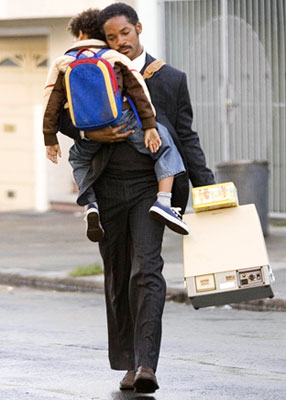
This is a long candid shot taken from the feature film ‘Pursuit of Happyness’ (Muccino, G. 2006). The sequence involves the main character ‘Chris Gardner’, Will Smith’s character who has just picked up his (in and out of film) son ‘Christopher' from play school.
The short focus shot reveals a location and the two main characters representing how the characters are most important, although it is obvious that the location is somewhere within a suburban city in America due to the typical pavement and common building designs.
The image’s angle is at eye level keeping the composition fairly neutral, making it seem as though the readers are a person at that present time observing. In the background a building has a metal barred gate, which could be argued for safety reasons giving connotations of a rough area. The composition has no bright or happy colours apart from several on the little boy’s bag centred in the middle of the shot which could symbolize the lack of happiness in their life yet the boy is the only small part of happiness left.
‘Christopher’ is being carried by one of his father’s arms, yet he is not holding onto him for support or affection giving the audience a sense of how ‘Chris Gardner’ is alone and has no one looking out for him or to confine in. How ‘Chris Gardner’ is holding the child seems to resemble a shield as if he’s the only thing keeping him from breaking point. Will Smith’s character is carrying in his other hand an unusual looking cream covered machine. It is a bone density scanner, which he attempts to sell however they are seen as overpriced and unnecessary. The machine mirrors the cream door on the right of the composition, which could be argued as a connotation of their home because it is recognizable to them and is the only material object they have left resembling their house and to state as theirs. The abnormal machine is not a stereotypical item anyone would think of when a man in a suit is present. A signified concept of a suit is a smart business outfit, which over time has created the myth that if a man wears a suit he is a heterosexual, authoritative and independent man in control of his life. This could give illusion that the main character is in disguise and is trying to better himself because the decoders know that he doesn’t fit the present myth due to the lack of money and power, however this could suggest his past will not let him become what he aspires to be, which suggests that the text is reinforcing ideology about captialist patriarchy.
The two characters are black and poor which link back to a myth about the past and how the white were in power and had the money in opposition to the black people who were slaves to the white and got paid hardly anything. It could be argued that the director did this to remind the audience about the capitalist issue of patriarchy. It is debatable that Gabriele Muccino wanted his film to have the preferred reading that the audience will want to care for the twosome, want them to be protected, have a nice home and enough money to have a secure and happy life. If this is the case and the preferred reading has been accepted it shows how the past white versus black hegemonic rules shouldn’t apply because black people are the same as the rest of us.
The short focus shot reveals a location and the two main characters representing how the characters are most important, although it is obvious that the location is somewhere within a suburban city in America due to the typical pavement and common building designs.
The image’s angle is at eye level keeping the composition fairly neutral, making it seem as though the readers are a person at that present time observing. In the background a building has a metal barred gate, which could be argued for safety reasons giving connotations of a rough area. The composition has no bright or happy colours apart from several on the little boy’s bag centred in the middle of the shot which could symbolize the lack of happiness in their life yet the boy is the only small part of happiness left.
‘Christopher’ is being carried by one of his father’s arms, yet he is not holding onto him for support or affection giving the audience a sense of how ‘Chris Gardner’ is alone and has no one looking out for him or to confine in. How ‘Chris Gardner’ is holding the child seems to resemble a shield as if he’s the only thing keeping him from breaking point. Will Smith’s character is carrying in his other hand an unusual looking cream covered machine. It is a bone density scanner, which he attempts to sell however they are seen as overpriced and unnecessary. The machine mirrors the cream door on the right of the composition, which could be argued as a connotation of their home because it is recognizable to them and is the only material object they have left resembling their house and to state as theirs. The abnormal machine is not a stereotypical item anyone would think of when a man in a suit is present. A signified concept of a suit is a smart business outfit, which over time has created the myth that if a man wears a suit he is a heterosexual, authoritative and independent man in control of his life. This could give illusion that the main character is in disguise and is trying to better himself because the decoders know that he doesn’t fit the present myth due to the lack of money and power, however this could suggest his past will not let him become what he aspires to be, which suggests that the text is reinforcing ideology about captialist patriarchy.
The two characters are black and poor which link back to a myth about the past and how the white were in power and had the money in opposition to the black people who were slaves to the white and got paid hardly anything. It could be argued that the director did this to remind the audience about the capitalist issue of patriarchy. It is debatable that Gabriele Muccino wanted his film to have the preferred reading that the audience will want to care for the twosome, want them to be protected, have a nice home and enough money to have a secure and happy life. If this is the case and the preferred reading has been accepted it shows how the past white versus black hegemonic rules shouldn’t apply because black people are the same as the rest of us.


